


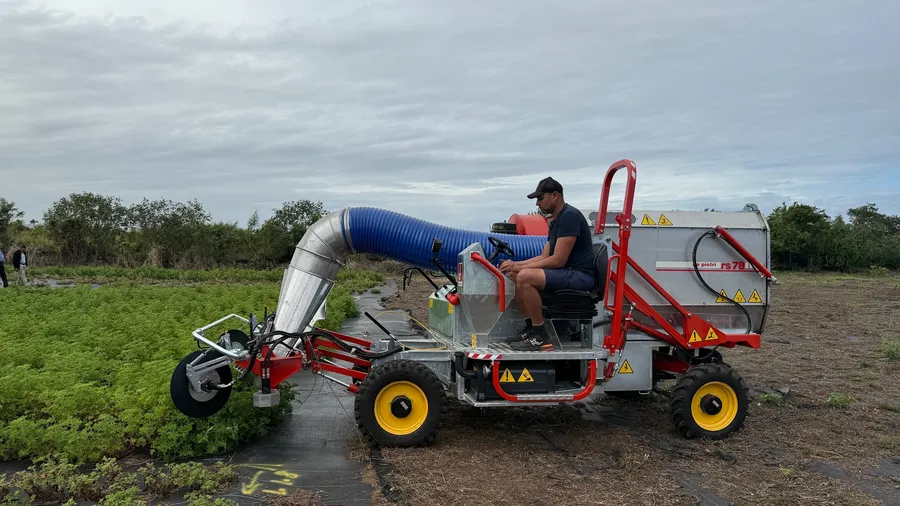
De Pietri launches the first geranium cutting machine
What do a farmer on a French island in the Indian Ocean and an Italian company that manufactures horticultural harvesters have in common?
Seemingly nothing, but you will be surprised to learn that they have a flower in common.
We have always underscored the importance of customization in our process of designing and manufacturing horticultural machinery.
At De Pietri, we are convinced that there is no single, uniform solution for all types of harvesting and have written an article on the subject to highlight some of the aspects that can make a difference when purchasing new machinery. Often, the most obvious choice is not the only option, nor the most effective.
Today, we will prove it to you by describing one of our projects, a very challenging one and, at the same time, surprising even for us.
Once upon a time in Rèunion
We are talking about an overseas department of France, a small island off the coast of Madagascar. It was precisely here that a farmer had a very specific problem: he needed to resume the production of geraniums, a long-since lost tradition.
An important mission, given that this flower is grown for the perfume industry, particularly thriving in France and always on the lookout for innovative suppliers.
At the outset, the customer did not mention harvesting the flowers: he merely asked whether a double blade could be fitted to our RS78 trimmer. This machine actually has another focus: it was designed to cut greenhouse plants and collect the clippings using an air suction system.
But the customer was foresighted. According to his experience with the crop, by adding a blade, the machine could be adapted for harvesting geraniums.
Ingenious, wasn’t he?
So let’s see what happened next.
The approach that guided us
Our machines must solve problems, not create new ones
Giacomo De Pietri
The customer had the right idea, but we couldn’t just forge ahead in the dark.
Whenever we at De Pietri customize a machine based on an existing model, we always make sure that it is as sturdy e efficient as the original.
In this case, we had to check that the modification requested would be unable to cause any technical or reliability problems.
Even the slightest change can sometimes affect the performance of a harvester, so it is important to thoroughly analyze each customization proposal and each project based on its specific characteristics.
This time we faced a double challenge:
- We had to make a structural modification to the machine using components already in stock, adapting them to the trimmer;
- We also had to consider that the original intended use of the machine had changed: a trimmer designed to clean up harvesting debris by suction does not take harvesting conditions into account, whereas this is a crucial factor in floriculture.
Flowers, on the other hand, are very delicate: specific research on cut flowers reports that losses within the supply chain can exceed 30-35% of the business value.
Flower growing needs precision, but at the same time large production volumes are also required to ensure that losses have as little impact as possible on the harvest, thereby optimizing the process.
This is why we took up the challenge while paying particular attention to the reliability of the machine and respect for the raw material during harvesting.
How did we do it?
A matter of teamwork
To customize the machine as required, we had to fit a double-blade cutting bar, a solution already used for other models.
Some components had to be designed and made from scratch to adapt those already fitted on the machine. This led to longer lead times but, true to our standard practice, we still managed to deliver the machine within 4 months of order.
How did we ensure that performance would remain consistent at every stage?
As the project progressed, our technical department drew up a check-list of items to be verified during production in order to test the safety and functionality of the machine at every stage of its conversion.
Once the machine had been completed, the customer came to visit us and we reviewed the project together.
Meeting the customer in person is a decisive step
It enables us to hear the needs and views of the actual customer first-hand, since it is he who knows all about the vegetable or flower to be harvested. This allows us to refine certain structural features and to tailor them to the individual customer’s requirements.
After the changes we made, the RS78 trimmer was perfect for the crop thanks to the air suction system built-into the machine and the additional blade: the flowers are drawn into the loading dump without suffering contamination.
Without this process, much of the value acquired during the development stage would probably be lost and the result would not be up to standard.
/outremer%2F2025%2F08%2F21%2Fgeranium-machine-68a718c4a7fc5913334018.jpg)
Towards a new era for harvesting geraniums and other delicate flowers
This project was challenging and gave us a new perspective regarding our trimmer. It shows how solutions often lie in trying a different approach, in opting for unconventional ideas.
The standard way is not always the best way for your field.
We at De Pietri are proud of the support we gave our customer, but that’s not all: thanks to this machine we were able to help revive a crop production lost across generations, one that will flourish again, stronger than ever.
“By the end of 2025, I’ll have two hectares of geraniums. We had stopped growing them as a family owing to the difficulties, but now we can start again.”
Thierry Lauret, farmer in Le Tampon
If you have a crop that requires a specific approach, or if standard machinery fails to meet your needs, don’t give up.
We can always discuss the development of a customized system together.