


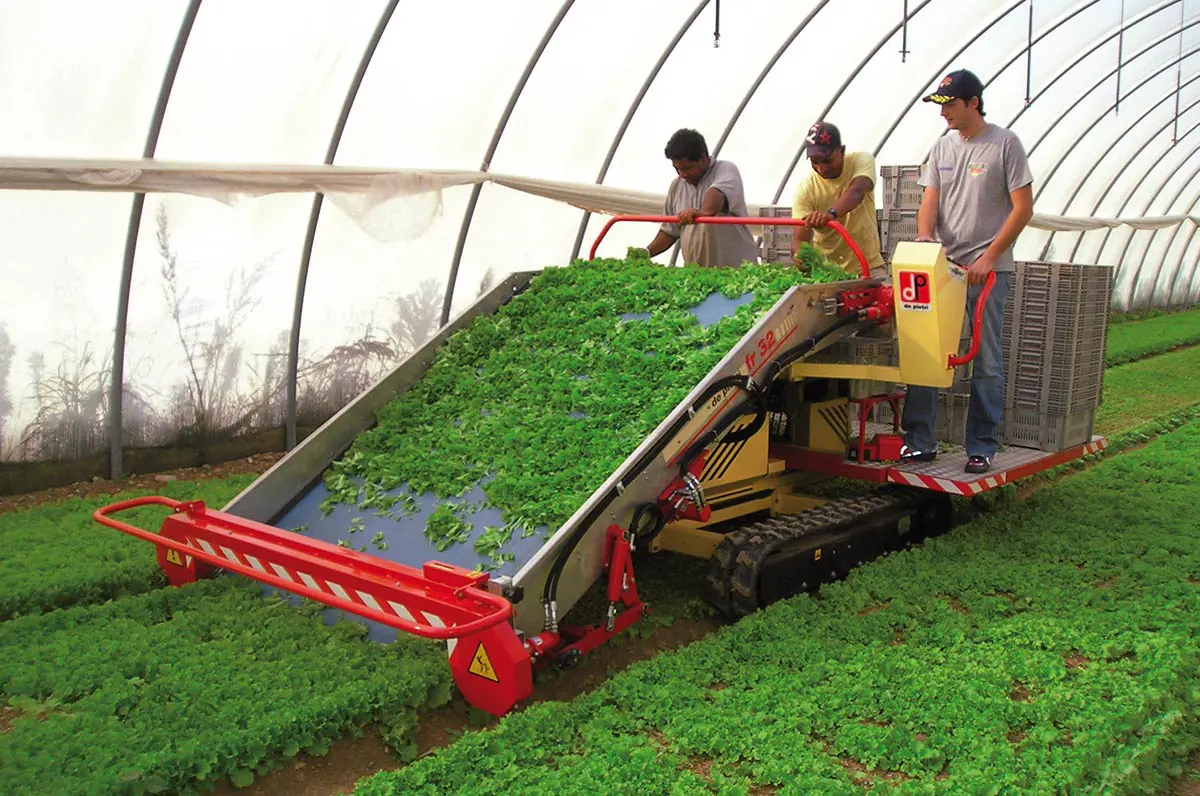
Tracks or Wheels? Tips on how to choose farm machinery
Choosing from between a track- or wheeled drive system is not just a matter of preference but a strategic decision that affects the productivity, safety and running costs of your farm. At De Pietri, we design machines capable of adapting to various contexts: here is a detailed analysis to help you decide which configuration to choose.
Tracked farm machinery: maximum stability and tractive force
Tracks are the preferable choice for work in extreme conditions, where the terrain leaves no room for error.
The advantages of tracked farm machinery
Performance in wet conditions
The broad footprint prevents the machine from getting bogged down in muddy or extremely wet conditions.
Maximum stability
For machines with extra-large work platforms, tracks provide a solid base that drastically reduces sway.
Unrestricted manoeuvrability
Since the machine can rotate on itself it can operate with ease in even the tightest spaces, typical of intensive vineyards or orchards.
Key points to consider
Road transfer
The machines can only move slowly because the system is rigid and unable to cushion uneven road surfaces.
Maintenance
The presence of track rollers, bushings and track links leads to greater wear and tear and, consequently, higher maintenance costs in the long term.
Wheeled machinery: speediness and versatility
Wheels are synonymous with agility. They are the ideal solution when your plots are far apart from each other and the soil is mainly compact.
The advantages of wheeled farm machinery
Ride-comfort and rapidity
Tyres provide natural shock absorption, making road travel faster and less tiring for the operator.
Cost-effectiveness
Since there are fewer moving mechanical parts there is less wear and tear, while routine maintenance is much simpler and more cost-effective.
Flexibility of use
Wheeled machinery adapts perfectly to different types of terrain without damaging concrete or asphalted surfaces.
Key points to consider
Risk of punctures
Contact with sharp objects could cause unscheduled downtime due to flat tyres.
Limits in muddy terrain
Tyres tend to lose grip in heavy rain.
Tracks or wheels: which to choose?
| Feature | Tracks | Wheels |
| Grip on muddy terrain | Excellent | Limited |
| Platform stability | High | Medium |
| Maintenance costs | Medium-high | Low |
| Road speed | Low | High |
FAQ
Which of the two options retains its value best over time?
Specialist tracked machines tend to depreciate less on the second-hand market. Their ability to operate on steep slopes or in heavy mud makes these machines hard to find and much in demand. While wheeled machines are more vulnerable to competition from standard models, tracked machines maintain an advantageous position thanks to their specific technical features.
Are tracked machines really more expensive than wheeled ones?
Tracked agricultural machinery tends to be more expensive to purchase and service compared to wheeled alternatives: it is important to bear in mind that tracks allow you to operate in the fields under heavy rainfall where a wheeled machine would be unable to work. This means that, depending on the area in which it operates, the tracked machine can boost productivity and the relevant return on investment.
Do tracks really reduce soil compaction?
Yes. Since the weight is distributed over a larger surface area, the ground pressure is less than that of a tyred machine. This preserves the structure of the soil and promotes crop health.
Which is the safest option on slopes?
Thanks to their lower centre of gravity and larger footprint, tracked machinery is generally more stable and able to reduce the risk of slipping sideways on slopes.
Can I drive a tracked vehicle on the roads?
It depends on the type of track (steel or rubber) and the machine’s circulation permit. Many of our solutions are designed to facilitate transport, but it is always advisable to check your local regulations or contact our technical department.
Does the choice of drive system affect fuel consumption?
Wheels are more efficient on hard ground or roads. However, tracks reduce the risk of skidding on difficult terrain, thereby preventing unnecessary fuel wastage caused by loss of grip.
De Pietri’s advice
There is no single best solution, just the best solution for your needs. If you operate on flat ground and have to move around a lot, then wheels would be the right choice. On the other hand, tracks would be an investment that pays off in productivity when the terrain is difficult and you need an ultra-stable work platform.
Would you like a customized configuration for your next machine?
Contact us for a free technical consultation.